

Let’s Start With the Bear
AI can generate a cinematic forest, place a talking bear in the middle of it, and give him a tiny espresso cup before lunch.
Impressive.
Now ask it to show the same bear from another angle. Suddenly, the cup is a mug. His jacket has disappeared. One ear is larger than the other. And for reasons nobody can explain, there is a second bear standing in the background wearing sunglasses.
That pretty much sums up where we are.
AI is an amazing tool. The progress in video generation over the past few years has been difficult to ignore. What once looked like a strange dream reconstructed from memory can now look surprisingly polished.
Sometimes, it looks extraordinary.
But can it replace an experienced creative team?
I would not clear out the studio just yet.
Yes, the Market Is Changing
There is no honest way to say AI is not affecting motion design. It is.
Routine assignments are becoming easier to produce. A marketing team can generate images, write scripts, create voiceovers, remove backgrounds, assemble rough footage, and make simple animations without hiring a specialist for every step.
That changes expectations. It changes timelines. It also changes what people assume creative work should cost.
The lower end of the freelance market will probably feel this first. Generic logo animations, template explainers, basic social content, simple cutdowns, and stock-footage edits are becoming faster and more accessible.
The U.S. Bureau of Labor Statistics expects employment for special-effects artists and animators to grow 2% from 2024 through 2034. It also notes that improvements in AI video-generation software may streamline parts of the work and limit demand for certain routine tasks.
Routine production is becoming easier to automate.
Judgment is not
The Work Is Not Disappearing. It Is Moving.
Something else is happening alongside all the talk about replacement.
Companies are actively looking for creative people who understand AI.
Upwork reported that demand for AI video generation and editing increased 329% year over year. That does not mean traditional video skills suddenly became irrelevant. It suggests clients increasingly want people who understand both the craft and the new tools entering it.
The choice is not always human or AI.
More often, it is becoming someone who understands the work and knows how to use AI, or someone who knows how to generate something but may not understand why it works.
Those are very different things.
You can ask AI to give you ten openings for a product story.
It can help.
You can ask it to challenge your first idea, find the weak point, argue from the customer’s perspective, or suggest a direction you had not considered.
That can be incredibly useful.
But it may also give you ten variations of the same idea wearing different hats.
A creative person still has to recognize the one direction worth pursuing.
AI Can Be a Creative Partner
This may be where AI is most valuable to me.
Not as the person driving.
More like someone sitting in the passenger seat who has read almost every map, occasionally notices a road you missed, and sometimes confidently tells you to drive into a lake.
You still have to steer.
When I am working through a story, I can use AI to expand the idea. What are we overlooking? What would make this more relevant to a marketing leader? What objection might the audience have? What happens when we tell the story from the customer’s point of view rather than the company’s?
I can ask it to challenge the concept.
Make the argument against it.
Find the part that sounds too familiar.
Those questions can push an idea somewhere new. AI can help you move past the first answer, which is often the answer everyone else has already found.
It becomes a collaborator in the process.
But collaboration does not mean surrender.
I use it to enrich my creativity, not relinquish it.
Simple Tasks Are Not Always Simple
One of the biggest misunderstandings about AI is that everything happens instantly.
Sometimes it does.
Sometimes you spend an hour asking it to move a person six inches to the left without changing the person, the lighting, the room, the camera angle, the furniture, or the laws of physics.
Small changes can consume enormous amounts of time.
You generate the right expression, but the clothing changes. You get the right camera movement, but the product bends. The character looks perfect, but the background now contains a door that leads nowhere.
The prompt gets longer.
The result gets stranger.
The afternoon disappears.
People see the final eight-second clip and assume it took eight seconds to make. They do not see the discarded generations, corrections, cleanup, compositing, editing, sound, timing, and the 47 attempts required to convince a human hand to contain five fingers.
AI can accelerate the work.
It does not automatically remove the work.
Where It Has Already Helped Optious
We completed a fast-turnaround project built around a collage-style visual direction.
It required a large number of photographs to be isolated from their backgrounds. Normally, that means someone spending hours (days even) carefully cutting around people, clothing, hair, furniture, and every small detail needed to make the compositions work.
However It is also not the part of the process where we want our best creative energy disappearing.
We combined AI-assisted tools with Photoshop to speed up the image-cutout process. Then we reviewed, corrected, and refined the assets before they entered the animation.
It worked extremely well.
AI did not choose the images. It did not establish the visual direction, build the compositions, determine the pacing, or decide how the final story should feel.
It removed a bottleneck.
That gave our team more time to concentrate on the work the audience would actually notice.
When Movement Needs to Feel Human
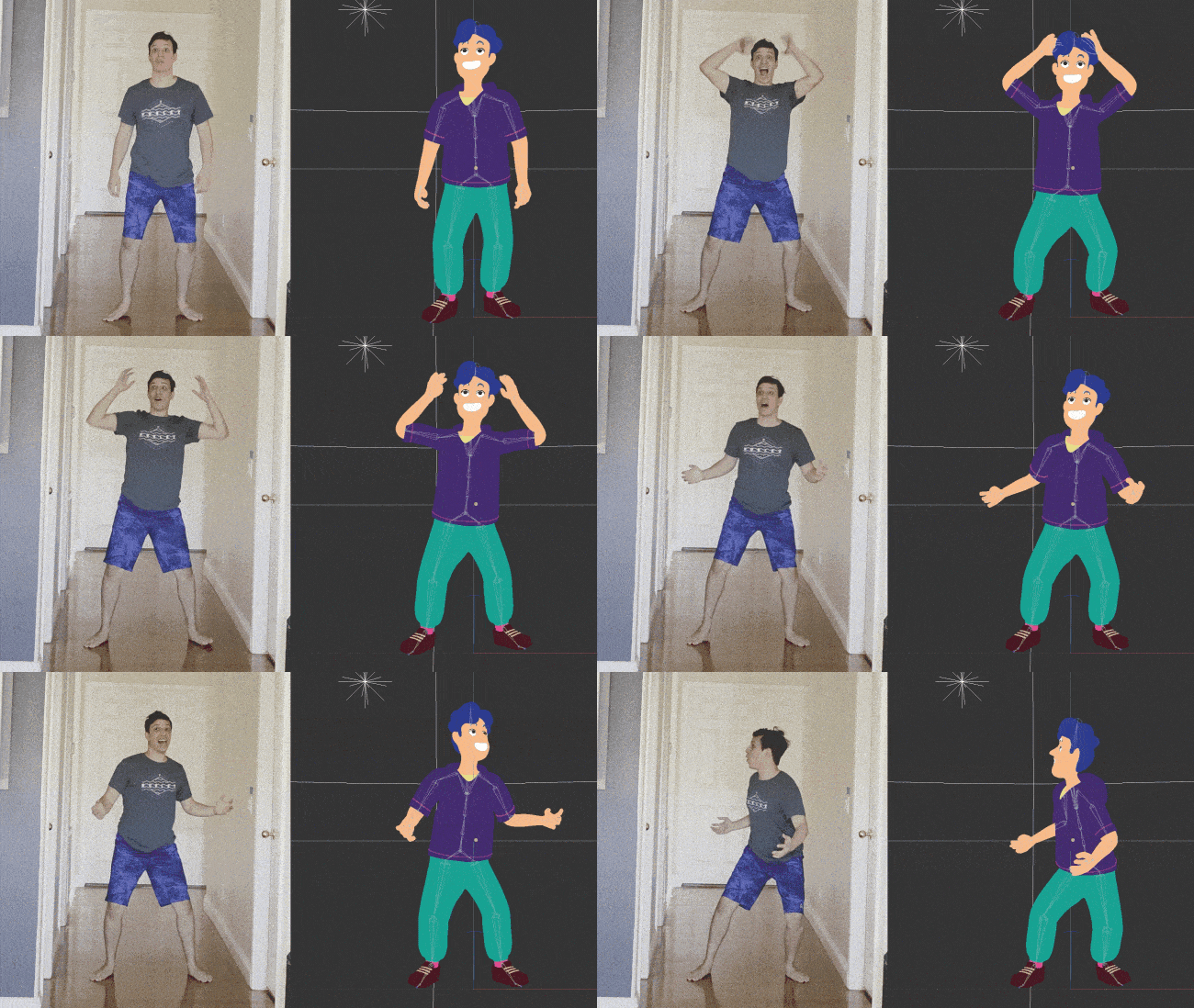
We also used AI-assisted motion capture for a 3D character animation.
Instead of building the entire performance manually, movement could be captured and translated to the character much faster. From there, we brought everything into Cinema 4D, where we shaped the animation, adjusted the timing, refined the performance, and integrated it into the larger piece.
The result came out exactly as I had envisioned it.
And it happened faster. That is an ideal use of AI. The vision remained human.
The tool helped us reach it more efficiently.
There is an important difference between using technology to eliminate the creative decision and using technology to execute that decision with less friction.
We are interested in the second one.
How We Use AI at Optious
At Optious, AI is becoming part of the workflow in several ways.
We use it for research and strategy. It helps us gather information, examine an industry, pressure-test assumptions, and explore what matters to the audience.
We use it to develop and expand ideas. A rough concept can become five possible story directions. One of those directions can be challenged, turned upside down, or rebuilt from another point of view.
We use it for marketing and operations. It helps organize information, evaluate messaging, identify opportunities, and reduce some of the administrative work that competes with creative time.
We also use it in production when it can remove repetitive labor, accelerate technical processes, or help us realize a specific idea.
And we are beginning to use AI-generated images and video selectively to develop concepts, enhance visuals, and improve production speed.
Not because every project needs it.
Not because it is fashionable.
What We Are Not Handing Over
We are not pressing a button, downloading whatever appears, and calling it an Optious production.
A strong marketing video is not a collection of attractive frames.
It has to communicate the right idea.
The pacing must carry the viewer forward. The visual choices need a reason to exist. The product has to be represented accurately. The sound must support the story.
And the final result has to feel like the company it represents.
Not every AI company.
Not every SaaS company.
Your company.
That requires context.
It requires taste.
It requires knowing that when a client says, “It needs more energy,” they may not be asking for faster animation. They might be telling you the opening lacks tension, the music feels too safe, or the message takes too long to reveal itself.
A prompt box does not always understand what someone is trying to say.
An experienced team learns how to listen beneath the words.
The Better Question for Marketing Leaders
The question is no longer, “Does your creative partner use AI?”
Most probably do.
The better questions are where do you use it, what does it improve, and what remains in human hands?
Does it create more room for strategy and original thinking, or does it simply allow the team to produce more things?
More content is not automatically better content.
Faster is only helpful when you are moving in the right direction.
Adobe’s research found that brainstorming stands out as one of the creative tasks where AI use and positive sentiment are both high. Separate Adobe research found that 90% of surveyed creators believed generative AI could help relieve menial tasks and support creative brainstorming.
That matches our experience.
AI is good at opening doors.
People still need to decide which one to walk through.
Do Not Fire Everyone Yet
AI will continue to improve.
Small animations will get easier. Generated footage will become more consistent. Today’s awkward production process will become tomorrow’s menu option.
We should welcome that.
Creative people have always adopted tools that help them work more effectively. Digital cameras did not eliminate photography. After Effects did not eliminate the need to understand timing, movement, composition, or story.
AI will remove some tasks.
It may reshape entire job descriptions.
But the World Economic Forum expects both technical AI capabilities and human skills such as creative thinking, resilience, flexibility, and curiosity to grow in importance.
That combination is the real future of creative work.
Technology and judgment.
Speed and direction.
Exploration and restraint.
AI can generate the bear.
Our job is to know whether the story needed a bear in the first place.
And if it did, to make sure he is still holding the same coffee cup in the next shot.
How is your team using AI right now? Is it helping you reach better ideas, or is it mostly helping you produce more things?
Reply and tell me.
I would genuinely like to know.
Sources: U.S. Bureau of Labor Statistics, Upwork, Adobe, and the World Economic Forum.
Thanks for reading our article!
If you need a video that helps position your brand, sharpen your message, and make your product easier to believe in, let’s talk.